Call local rate
Mon - Fri 8:30am - 7pm | Sat - Sun 9am - 5pm
Call local rate 0330 383 0319
Mon - Fri 8:30am - 7pm | Sat - Sun 9am - 5pm
Call us: Mon - Fri 8:30am - 7pm, Sat - Sun 9am - 5pm

Your local civil partnership dissolution solicitors

Dissolution is the legal process for formally ending a civil partnership in England and Wales. Under the Civil Partnership Act 2004, it requires an application to court confirming that the civil partnership has irretrievably broken down. Since April 2022, dissolution has followed the same no-fault framework as divorce – meaning neither partner needs to assign blame or prove any wrongdoing.

Dissolution does not resolve everything on its own. Financial matters and any arrangements for children are handled separately, though they can run alongside the process. Getting advice early gives you a clearer picture of what to expect and helps things progress more smoothly.

At Stowe Family Law, our solicitors support civil partners at every stage. From preparing and submitting court paperwork, to advising on financial and child-related matters, supporting negotiations with your former partner, and representing you in court if needed. You do not need to have all the answers before you reach out.

As the UK’s largest specialist family law firm, we have more than 90 offices across England and Wales, including London, Manchester, Leeds, Birmingham, Sheffield, Bristol, and Cardiff. We are ranked by Legal 500 2026 and Chambers & Partners 2026, named among The Times Best Law Firms 2026, and rated Excellent on Trustpilot. As members of Resolution and regulated by the Solicitors Regulation Authority, you can expect honest, constructive advice throughout.


Key divorce information

How much does a divorce cost?

  • Standard court fee to process the divorce application: £628 +VAT
  • Average solicitor fees (in an uncontested divorce): £750 +VAT.
  • In low complexity financial or child arrangement cases: from £4000 to £25000. Where there are more complex issues to resolve, costs can extend beyond this.

It’s essential to speak to a solicitor to get realistic divorce costs for your specific situation.

How long does a divorce take?

On average, between 6 and 8 months.

Are pensions included in a divorce?

Yes, it’s important to include any pensions when submitting financial information.

Am I eligible for a fixed-fee divorce?

Fixed-fee divorces are only suitable when there are no financial or child arrangements to resolve. Complex cases would not be eligible for this model.

Do I need to go to court?

You’ll only need to go to court if you’re unable to reach an agreement through other methods such as mediation and arbitration. Over 80% of our cases are settled out of court.

See more answers to common questions

Related services

Financial settlement solicitors

If you have developed any joint finances with your ex-partner during your civil partnership, you will need the help of a solicitor to get a financial settlement. While dissolving your civil partnership legally ends it, the process does not legally sever financial ties with your ex. Our solicitors will help you divide your assets and get the final Consent Order, legally ending your joint finances and protecting you from any future claims.

Divorce financial settlement solicitors
Financial settlements when getting divorced

Child arrangement orders

If you have developed any joint finances with your ex-partner during your civil partnership, you will need the help of a solicitor to get a financial settlement. While dissolving your civil partnership legally ends it, the process does not legally sever financial ties with your ex. Our solicitors will help you divide your assets and get the final Consent Order, legally ending your joint finances and protecting you from any future claims.

Child arrangement order solicitors

Spousal/civil partnership maintenance

Spousal or civil partnership maintenance is a regular income payable from one partner to the other to assist in their regular income needs. There are the same legal responsibilities for civil partners as there are for married couples when it comes to financial support on separation. Once you have completed your civil partnership dissolution, you will need legal advice on this as you may be required to make payments or be entitled to receive them. Our solicitors can represent either party when negotiating any financial agreements.

Spousal support lawyers
What is spousal maintenance (UK)?

Child maintenance

Child maintenance is a regular payment made from the parent who does not live with the child to the parent with the child day-to-day to cover the child’s living expenses. This is decided separately from child arrangements and from the dissolution of your civil partnership. If you can’t come to a fair decision yourselves as to what maintenance payments are needed, you will need the help of a solicitor. We can represent you and draft any documents in the process of settling the legal dispute.

Child maintenance solicitors

Mediation

Civil partnership mediation is a voluntary and impartial service where a trained mediator helps couples separating reach agreements together on issues such as financial settlements, property disputes and child arrangements. This is often quicker than going through the courts directly and a more cost-effective option. We can provide you with a trained mediator or provide legal support if you are using an external mediator.

Mediation solicitors

Not sure which service you need?

Use our service selector tool

Divorce Calculator: Understand what you may be entitled to in just 5 minutes. Use the calculator

How do you dissolve a civil partnership?

The process of ending a civil partnership is known as dissolution. Before you can apply you must have been in a civil partnership for a year.

read more

Just as people in a civil partnership benefit from the same rights as married couples in terms of tax benefits, pensions and inheritance, ending a civil partnership provides the same entitlements as a spouse who gets divorced.

As with divorce proceedings, dissolving a civil partnership is completed by the court. As part of the process, you can apply for financial provision by way of a lump sum, property transfer, maintenance and pension sharing orders.

There are four key stages in the civil partnership dissolution process:

  1. Complete a dissolution application as either a sole applicant or as a couple as joint applicants.
  2. Submit the application to a divorce centre either online or by post with the correct court fee – currently £628.
  3. Apply for a conditional order (once the application is acknowledged by your partner and after a 20-week cooling-off period).
  4. Apply for a final order (six weeks after you have the conditional order). This order legally ends your civil partnership.
  5. However, the act of dissolution itself does not put an end to the financial relationship between you and your partner.

To separate your finances, you must reach a financial settlement, a legally binding decision on how assets and wealth will be split now that your partnership has ended. Arrangements for children will also need to be made if required but these are also dealt with separately from the divorce.

Our UK divorce lawyers will be able to guide you through the entire process so you have a clear understanding of what is expected at every stage. We’ll be there to share the burden and give you the support you need.

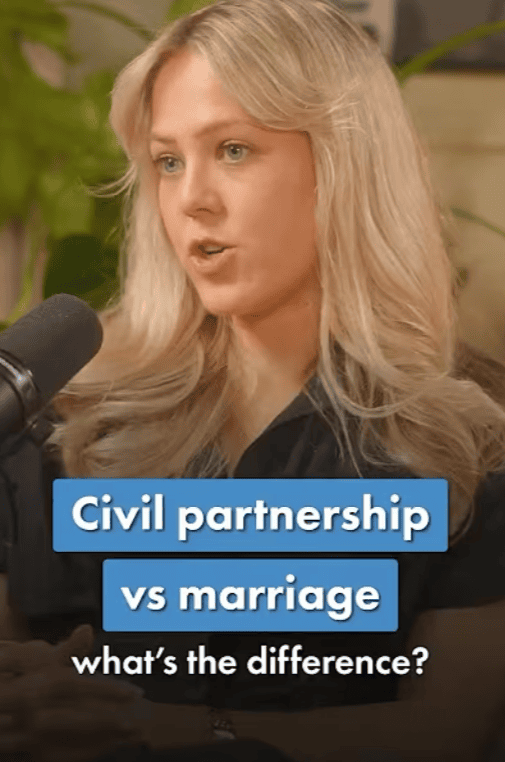
Civil partnership vs marriage - what's the difference?

What is the difference between divorce and dissolution?

The difference between divorce and dissolution is mainly the terminology. Divorce ends a marriage, whereas dissolution ends a civil partnership. The legal process for both is effectively the same.

Since the Divorce, Dissolution and Separation Act 2020 came into force in England and Wales in April 2022, both divorce and dissolution follow a no-fault framework. Neither party is required to assign blame or provide evidence of wrongdoing. In both cases, the applying party (or both parties jointly) makes a statement of irretrievable breakdown.

The stages are identical. You apply for a conditional order (previously known as a decree nisi), wait at least six weeks before applying for the final order, and the final order legally ends the civil partnership. The court fee is the same: £628 as of July 2026. The financial and child arrangement implications are also the same. Questions of asset division, property, and arrangements for any children are dealt with through the same court process regardless of whether a couple was married or in a civil partnership.

The divorce process

Application

One or both spouses submit a divorce application to the court using the HMCTS Portal, citing irretrievable breakdown of the marriage without assigning blame.
1
2

20-week reflection period

After the application is filed, and your former spouse has responded to the petition, a mandatory 20-week reflection period begins. During this time, spouses may also exchange financial information using Form E and address any necessary child arrangements, including including the time your children spend with you both.

Conditional order

After the reflection period, the applicant(s) apply for a Conditional order (previously known as Decree Nisi). The court reviews the case and, if satisfied, grants the order.
3
4

6-week waiting period

Following the Conditional order, there is a mandatory 6-week waiting period before the final step can be taken.

Final order

After the 6-week waiting period, the applicant(s) may apply for the Final Order (previously known as Decree Absolute), officially ending the marriage.
5
6

Average 9-12 months

If more than 12 months have elapsed between obtaining your conditional order and applying for your final order, you will have to submit a short statement to support your application, explaining the delay.

debunking divorce myths: i can get a quickie divorce

When can I end a civil partnership?

You can apply to dissolve your civil partnership in England and Wales once you have been in the civil partnership for at least one year. There is no minimum separation period before you apply, and there is no requirement to have been living apart before starting the process.

One year is calculated from the date your civil partnership was legally registered, not from the date you began living separately. If your civil partnership is less than a year old, you will need to wait until that threshold is met before the court can accept your application.

If you are unsure whether you meet the eligibility criteria, or if your situation involves any complexity (such as one partner living abroad or a dispute about the terms of the dissolution) speaking with a solicitor at the earliest opportunity will help you understand your position clearly.

Do I need to prove a relationship breakdown?

Under the no-fault process introduced by the Divorce, Dissolution and Separation Act 2020, you are not required to prove fault or establish specific reasons for the breakdown of your civil partnership. There is no need to cite behaviour, separation periods, or any conduct on your partner’s part.

What is required is a statement of irretrievable breakdown. This is a declaration that the civil partnership has broken down and cannot be repaired. The court does not scrutinise the reasons behind that statement or require you to justify it further.

If both partners agree to dissolve the civil partnership, you can apply jointly, which can simplify the process. If one partner does not agree, the other can still proceed – the no-fault process does not require both parties to consent.

It is worth noting that dissolution only ends the legal status of your civil partnership. It does not automatically resolve any financial matters between you. A separate financial order is needed to achieve a clean legal break and to protect both parties from future claims. Stowe’s lawyers can advise you on financial settlement, consent orders, and any arrangements for children as part of a comprehensive service.

Meet our expert civil partnership dissolution solicitors

Get expert advice and support tailored to your situation from our experienced legal team.

Trustscore 4.7 Excellent
2495
reviews Read our reviews
With over 90 offices nationwide, we're always within reach

We offer an award-winning service

How to: a beginner's guide to mediation Download our mediation guide

Solicitors for civil partnership dissolution

We know that the breakdown of any relationship, no matter the circumstances, can be an incredibly difficult and daunting situation to navigate. Whether your relationship has ended amicably or not, separation of any kind brings with it a unique set of complex challenges.

read more

At Stowe Family Law, our experts in the dissolution of civil partnerships will draw upon their years of experience in dealing with cases just like yours. Your civil partnership solicitor will guide you through the entire process with care, empathy and reassurance.

Obtaining early legal advice should not be viewed as a declaration of war. It is in fact a vital first step to ensure that you are fully informed of your options and able to have constructive discussions.

Why choose Stowe Family Law?

  • As the only national law firm fully dedicated to family matters, our expert team offers professional advice so you can make a fully informed decision about your divorce.

  • We are proud to be rated ‘Excellent’ on Trustpilot. Check out our reviews to see what our previous clients have said about our service.

  • We feature in The Legal 500 rankings and are fully authorised and regulated by the Solicitors Regulation Authority (SRA).

  • We keep you informed. Take a look at our support section, which features a range of helpful guides, focusing on important topics including finances and mediation.

Find out more about us

Common questions about civil partnership dissolution

Common questions about civil partnership dissolution

  • How much does it cost to dissolve a civil partnership?

    The initial court fee to begin the proceeding of the dissolution of your civil partnership currently costs £628 . You and your partner will need to come to an agreement on who will cover this cost.

    If you choose to work with a specialist civil partnership solicitor to help with the dissolution, there will be additional legal costs to cover for their services. The amount that you’ll have to pay will depend on how much work is required on your case but we’ll ensure you have a clear picture of what you’ll be expected to pay throughout the entire process.

  • What effect does the dissolution of a civil partnership have on a Will?

    Unlike other life events such as a marriage, going through a divorce or dissolution does not make your Will invalid. Instead, once you and your partner have separated and your civil partnership has been dissolved, your former spouse will be disregarded from your Will.

    Due to the effect of the S18A and S18C Wills Act 1837, your former partner will be treated as if they had died on the date of your dissolution, meaning that they are unable to act as an executor on your estate and will be legally removed from your Will.

    Once your civil partnership has ended, it’s advised that you update your Will as soon as possible. This is particularly important if you only had your former spouse as the singular executor for your estate, as you will need to make alternative arrangements for who you would like to inherit your estate in the future.

  • How quickly can you dissolve a civil partnership?

    How quickly your civil partnership can be dissolved will depend entirely on how your case progresses and whether you and your former partner can come to an agreement on the process of your dissolution.

    If both parties are in agreement on the terms of the dissolution and all documentation has been completed, then a dissolution normally takes anywhere between four to six months.

    If you and your partner are unable to reach an agreement during the dissolution process, this could considerably delay proceedings. This commonly happens when disagreements arise surrounding the division of financial assets in the wake of a separation.

    You may need to attain a financial settlement order to protect your finances by ensuring your former partner cannot claim a portion of your assets in the future.

    Your civil partnership dissolution may also take longer if your partner does not consent to the end of your relationship. If your partner contests your decision to end your civil partnership, you could find yourself faced with multiple court hearings which would delay the proceeding even further.

  • Is dissolution the same as divorce?

    The term divorce is often used to describe the breakdown of a legally binding relationship but, when it comes to civil partnerships, this route of legal separation is known as a dissolution.

    Both divorce and dissolution follow very similar legal processes. In both instances, the relationship must have been legally recognised for at least a year before you can apply for your separation.

    The initial court fees are also the same for a divorce or dissolution, currently £628. However, in both instances, if you decide to have legal representation throughout the proceedings, there will be additional fees to pay.

    Once the divorce or dissolution process has reached its end, you’ll be required to obtain a final order which will officially end your relationship in the eyes of the law. Our UK family lawyers can help to guide you through this process.

Filomena is Team Leader Partner, renowned for providing honest and clear client-focused advice, using a non-adversarial approach where possible and problem solving to resolve matters in the most effective way. She is based at our Chelmsford office.

Date last reviewed: 24/07/2026

Close

Newsletter Sign Up

Sign up for advice on divorce and relationships from our lawyers, divorce coaches and relationship experts.

What type of information are you looking for? (Optional)


Read about how we use your data in our Privacy Policy. To opt out at any time, select ‘unsubscribe’ in any of our marketing communications, or email [email protected].

Privacy Policy Close newsletter modal
Close
Close video player modal
Close
Close

Podcast:

Please enable marketing cookies to view this content.

Close podcast player modal
Close

Video:

Please enable marketing cookies to view this content.

Close video player modal